



Showing 1 - 10 of 20
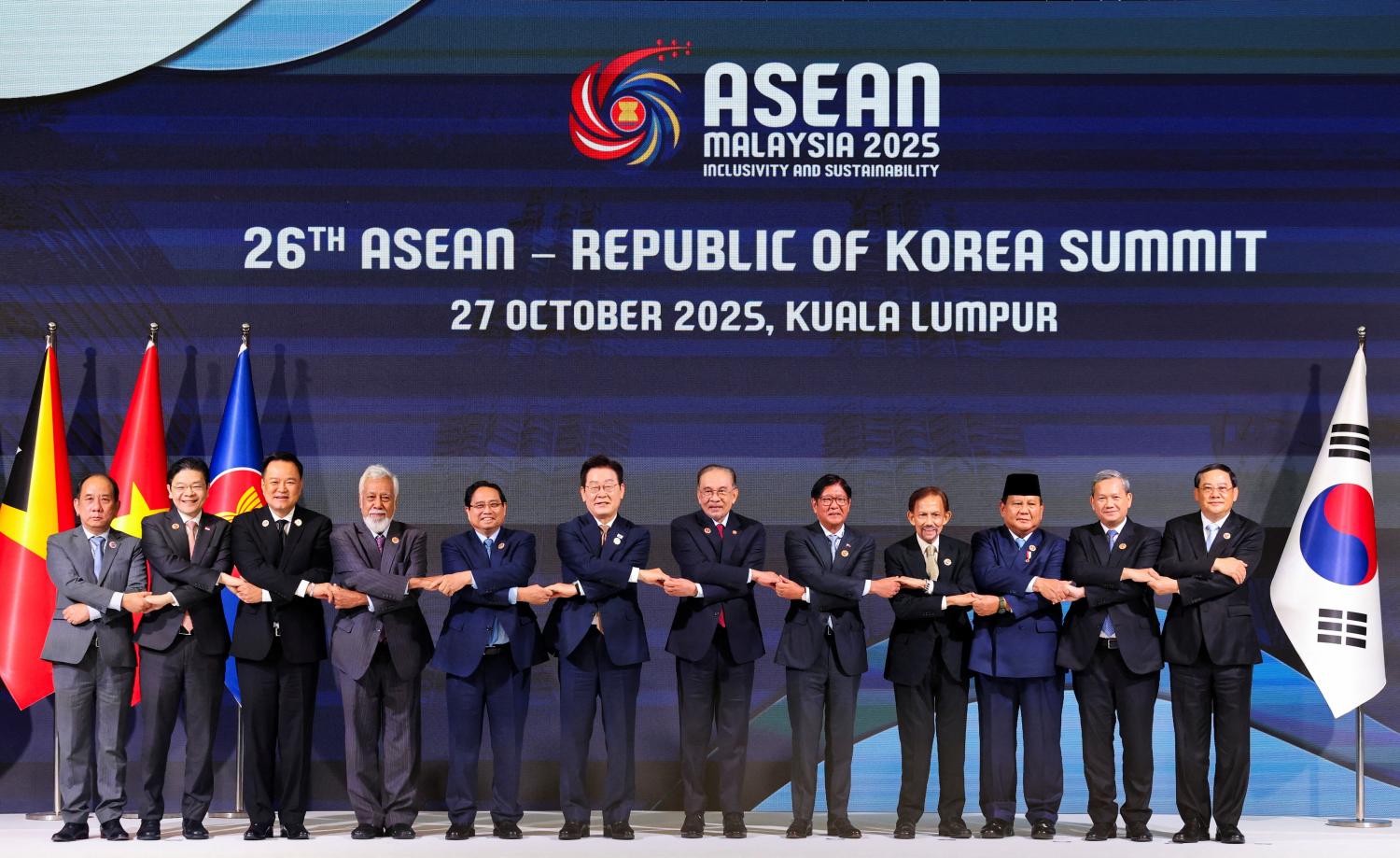
Recasting Korea–Asean relations
Oped, Suh Jeong-in, Published on 03/12/2025
» At the Asean–Republic of Korea (ROK) Commemorative Summit in Kuala Lumpur in October, President Lee Jae-myung presented a five-year vision for the Comprehensive Strategic Partnership (CSP).

Electricity will decide who wins the great AI race
News, Jeffrey Wu, Published on 20/10/2025
» The next stage of the global AI race will be decided not by algorithms or chips, but by electricity -- and that puts China at a distinct advantage. While Western tech giants are emphasising closed, capital-intensive models that demand enormous computing power, China is embracing open source AI and massively expanding its renewable- and nuclear-energy capacity, thereby positioning itself to deploy powerful AI technologies at scale without breaking the bank.

China's unbeatable new export is not a product
Oped, Jeffrey Wu, Published on 24/07/2025
» The Chinese "cannot be allowed to export their way back to prosperity", argues US Secretary of the Treasury Scott Bessent, who claims that China's economy is the "most unbalanced in history". Such remarks reflect the growing fear in Washington that China's overcapacity, subsidies, and dumping are distorting global trade.

US tariff shock upsides for Asean
Oped, Suh Jeong In, Published on 24/04/2025
» 'Let the dust from the White House settle first," said former Korean Foreign Minister Song Min-soon in an interview with Korean media. A Southeast Asian figure I met during an Asean Regional Forum (ARF) Experts and Eminent Persons (EEPs) meeting held recently in Kuala Lumpur, Malaysia, expressed a similar sentiment.

South Korea's Indo-Pacific policy
News, Suh Jeon-in, Published on 13/12/2022
» President Yoon Suk-yeol announced the Republic of Korea's Strategy for a Free, Peaceful, and Prosperous Indo-Pacific Region (hereafter Indo-Pacific Strategy), and Korea-Asean Solidarity Initiative (KASI) at the Asean-Korea Summit held in November in Phnom Penh, Cambodia. His core message at the summit was simple: Korea aims to upgrade and elevate its partnership with Asean to the next level. In response, Asean leaders welcomed President Yoon's initiative. The significance of Korea's recent diplomatic move should be analysed in diverse aspects.
Ending the war of attrition in Ukraine
Oped, Jeffrey D Sachs, Published on 12/05/2022
» Wars often erupt and persist because of the two sides' miscalculations regarding their relative power. In the case of Ukraine, Russia blundered badly by underestimating the resolve of Ukrainians to fight and the effectiveness of Nato-supplied weaponry. Yet Ukraine and Nato are also overestimating their capacity to defeat Russia on the battlefield. The result is a war of attrition that each side believes it will win, but that both sides will lose.
Diplomacy may save the world, sanctions won't
Oped, Jeffrey D Sachs, Published on 16/03/2022
» Russian President Vladimir Putin's war on Ukraine is horrific and barbaric. Yet it could still be ended with a diplomatic solution in which Russia withdraws its forces in exchange for Ukraine's neutrality.
How to protect the sovereignty of Ukraine
Oped, Jeffrey D Sachs, Published on 23/02/2022
» Ukraine's Western friends claim that they are protecting the country by defending its right to join Nato. The opposite is true. In defending a theoretical right, they are jeopardising Ukraine's security by raising the likelihood of a Russian invasion. Ukraine's independence could be defended far more effectively by reaching a diplomatic agreement with Russia that guarantees Ukraine's sovereignty as a non-Nato country, akin to Austria, Finland, and Sweden (all members of the European Union but not of Nato).

COP26 falls sadly short of financial 'grand plan'
Oped, Jeffrey D Sachs, Published on 18/11/2021
» The United Nations Climate Change Conference in Glasgow (COP26) fell far short of what is needed for a safe planet, owing mainly to the same lack of trust that has burdened global climate negotiations for almost three decades. Developing countries regard climate change as a crisis caused largely by the rich countries, which they also view as shirking their historical and ongoing responsibility for the crisis. Worried that they will be left paying the bills, many key developing countries, such as India, don't much care to negotiate or strategise.
The G20 and the means to climate safety
Oped, Jeffrey D Sachs, Published on 29/10/2021
» Philosopher Immanuel Kant famously said: "Whoever wills the end also wills… the indispensably necessary means to it that is in his control." Put simply, when we set a goal, we ought to take the actions needed to achieve it. This is an essential maxim for our governments, and it should guide G20 leaders when they meet in Rome tomorrow to confront the climate crisis.