



Showing 1 - 10 of 140
Our tariff-era dollar, your problem
Oped, Qiyuan Xu, Published on 04/02/2026
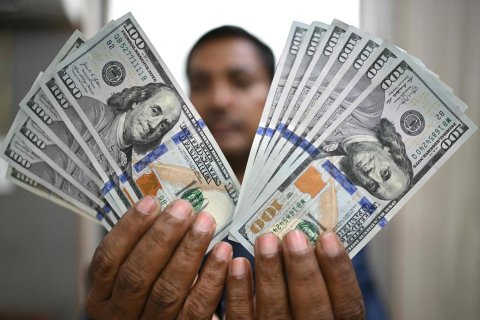
» In 2025, the dollar index, which measures the greenback's strength against a basket of major currencies, fell by roughly 9.4%. Over the same period, the United States' average effective tariff rate rose by around 14.4 percentage points, from 2.4% to 16.8%, according to the Yale Budget Lab. Taken together, these shifts imply that, in the import trade domain, the US experienced an effective exchange-rate depreciation of around 24%.

When infrastructure meets AI
Oped, Bertrand Badré & Saurabh Mishra, Published on 16/01/2026
» Infrastructure investment is booming. Around the world, governments are pouring trillions of dollars into roads, power grids, data centres, water systems, and housing, with many responding to intensifying climate shocks and the growing need for adaptation. Yet the construction industry -- the single largest force physically reshaping the planet -- is among the last major sectors to unlock all the benefits that digital technology offers. As a result, it accounts for about 21% of greenhouse-gas emissions, produces half of global landfill waste, and overspends by US$1.6 trillion a year.

Why being a “jack of all trades” is not failure
๋ีJuranan Soranet, Published on 05/01/2026
» The phrase “jack of all trades” initially sounds flattering, even admirable. In Thailand this concept is captured by a unique and vivid metaphor - the “Duck” or Ped.
Venezuela: Performative purging
Oped, Gwynne Dyer, Published on 09/12/2025
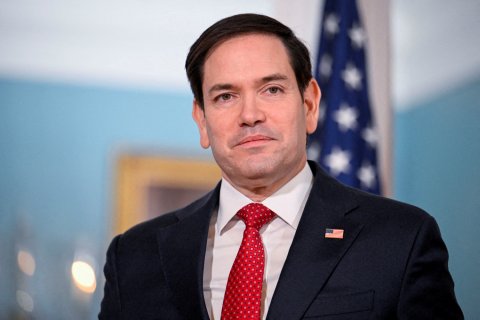
» 'If you're on a boat full of cocaine or fentanyl or whatever, headed to the United States, you're an immediate threat to the United States," said US Secretary of State Marco Rubio last week. So it's perfectly reasonable for the US armed forces to kill everybody on that boat (including a "double tap" on any survivors in the water).
Recasting Korea–Asean relations
Oped, Suh Jeong-in, Published on 03/12/2025
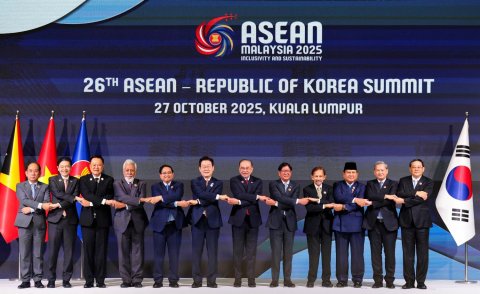
» At the Asean–Republic of Korea (ROK) Commemorative Summit in Kuala Lumpur in October, President Lee Jae-myung presented a five-year vision for the Comprehensive Strategic Partnership (CSP).

New tech disrupts global order
Oped, Mark Blyth & Daniel Driscoll, Published on 18/11/2025
» News media tend to focus on the world's major powers because they command more resources by dint of their relatively larger economies, militaries and energy endowments. But there are costs to such dominance. For example, a single American Gerald R Ford-class aircraft carrier costs $13 billion (421.6 billion baht), while the F-35 fighter jet costs about $100 million. So, if you can build your military equipment for less than your opponent, you can gain a strategic advantage.
Uniting Asia for common growth
Oped, Pisanu Suvanajata, Published on 04/09/2025
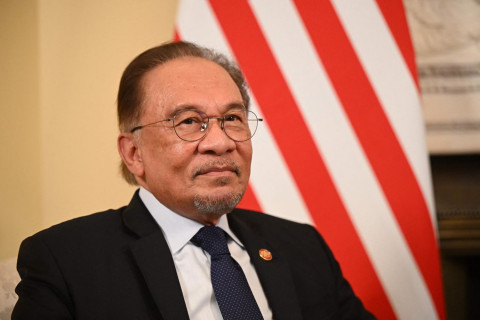
» Amidst the current geopolitical turbulence, eminent persons of the Boao Forum for Asia (BFA) gathered in Kuala Lumpur, Aug 26–27, to brainstorm pragmatic strategies and policy recommendations for Asia-Pacific countries to navigate challenges and advance towards a sustainable future.
Thai-Cambodian feud is Asean's worst
Oped, Thitinan Pongsudhirak, Published on 15/08/2025
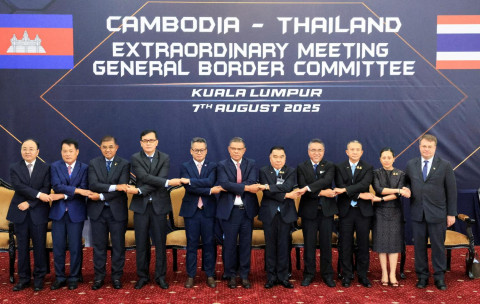
» The border dispute and consequent military conflict between Cambodia and Thailand in recent weeks have become Asean's worst crisis in its 58 years of existence. Ironically, it was an intra-regional war between Indonesia and Malaysia that gave rise to Asean in 1967, but now an intra-Asean military clash is undermining the Southeast Asian organisation's core reason for being and its main claim to credibility and prominence. Unless Asean, under Malaysia as its rotational chair this year, moves fast to contain the bilateral dispute and reinforce a delicate ceasefire agreement, Southeast Asia will be looked upon increasingly as a region and less as an organisation of member states.

Journalism is the first victim in a conflict
Oped, Kong Rithdee, Published on 31/07/2025
» In times of chaos, to call for calm seems naïve. "Imagine there's no countries." Sure, John, I know your utopianism was well-intended, but try telling that to the blood-hounding jingoists running rampant online in Cambodia and Thailand.

Southeast Asia facing hidden extremist threat
Oped, Muhammad Makmun Rasyid, Published on 07/07/2025
» In May, Indonesia's counter-terrorism unit arrested an 18-year-old man in Gowa, South Sulawesi, on charges of spreading Islamic State (IS) propaganda and inciting bomb attacks on social media. Identified only as MAS, the suspect represents a deeply troubling development in Southeast Asia's struggle against terrorism: the rise of youth radicalisation driven entirely by online exposure.