




Showing 1 - 9 of 9
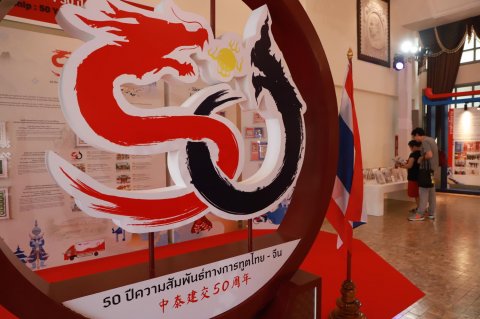
Thai-Sino ties take new steps
Oped, Zhang Jianwei, Published on 13/11/2025
» In China's diplomacy with neighbouring countries, the friendly relations between China and Thailand have always sparkled. The many "firsts" created in this relationship have vividly demonstrated the special bond of "China and Thailand are as close as one family" as well as a firm belief of the two countries in working hand in hand for common development, bringing great benefits to the people, and setting a shining example of regional cooperation.
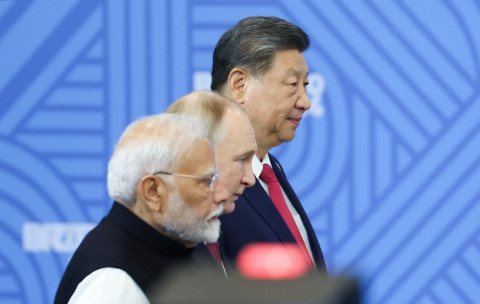
Middle Kingdom and 'boomerang effect'
Oped, Kasit Piromya, Published on 25/10/2024
» President Xi Jinping, on the eve of assuming the supreme leadership of China, came forward with the notion that China, the Middle Kingdom, lost its grandeur and supremacy in the middle of the 19th century to Western influence and encroachment, as well as the Japanese and island kingdoms that essentially acted as imperial Western powers inflicting military defeats against the massive but inadequate Chinese forces.

Sway of video games
Oped, Postbag, Published on 28/10/2023
» The Siam Paragon shooting a few weeks ago has largely been put into the background now, what with all the Thais stranded in the Middle East and other problems in the world.

The key to greener heavy industry
Oped, Keun Lee & John Mathews, Published on 30/08/2023
» For decades, solar and wind arrays offered a visible indication that the transition towards a green economy was progressing. But if we are to reduce -- and, eventually, eliminate -- carbon dioxide emissions, we will have to find a "clean" way not only to produce electricity, but also to power hard-to-abate heavy industries, such as steel, cement, and fertiliser production. Solar and wind energy alone cannot do this job, but hydrogen can.

Asean no-nuke treaty in perilous times
Oped, Kavi Chongkittavorn, Published on 13/06/2023
» The Thai word, chiew-chiew, which means relax and respond in kind, is a fitting description of Asean's current attitude towards the fiercely strategic competition between the United States and China.

Treat Uyghurs justly
Oped, Editorial, Published on 02/05/2023
» Shockingly, the Thai government remains tight-lipped about the fate of Uyghur refugees who have been held in detention for eight years after the recent deaths of two of them.
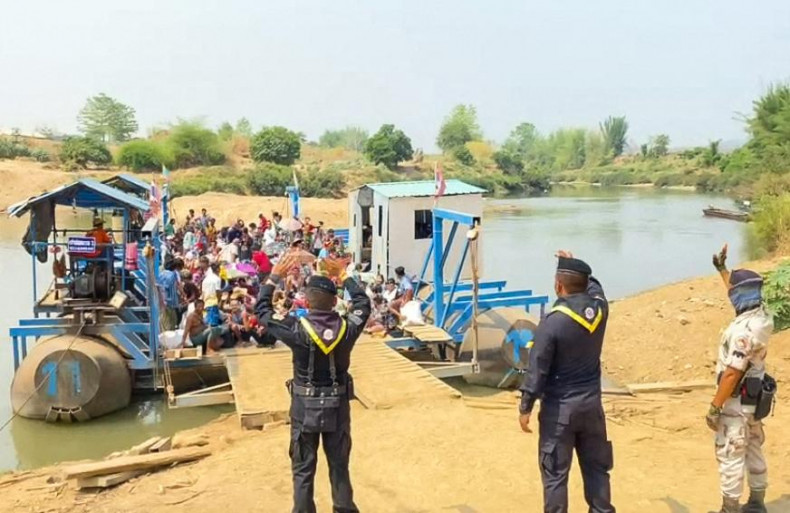
Thai diplomacy has come full circle
Oped, Kavi Chongkittavorn, Published on 18/04/2023
» After eight arduous years, Thai diplomacy has come full circle. With 26 days to go before the next general election on May 14, the international community is wondering whether there will be any change in the country's overall diplomatic outlook. Since the dark days leading up to the intervention in May 2014, Thailand has undertaken an extraordinary journey given the state in which the country was caught with its deteriorated standing in the global community. Critics varied in their assessments of Thai foreign policy under deep stress. Indeed, the long winding diplomatic road revealed both the strengths and weaknesses of strenuous efforts to protect national interests amid the competition of the great powers and in tackling the unavoidable ripple effects caused by an increasingly polarised world.

Fixing, shaping AI is in our common interest
Oped, Gabriela Ramos and Mariana Mazzucato, Published on 05/01/2023
» The tech world has generated a fresh abundance of front-page news in 2022. In October, Elon Musk bought Twitter -- one of the main public communication platforms used by journalists, academics, businesses, and policymakers -- and proceeded to fire most of its content-moderation staff, indicating the company would rely instead on artificial intelligence.
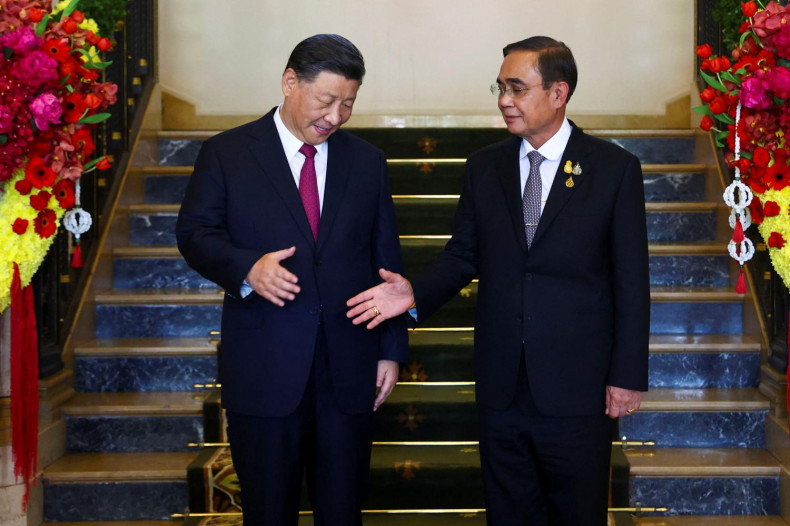
How did China surpass Thailand?
Oped, Peerasit Kamnuansilpa and Wei Yang, Published on 22/12/2022
» Thailand revolutionised its political and administrative systems in 1932, well before China, which did not start until 1949. The shared drive for this revolution was the economic hardship of the populace. Both Thailand and China were poor nations. Their economy stagnated and was under the control of the privileged groups, the elite rulers in the case of Thailand, and the bourgeois in China. People in the countryside were left with economic plight and suffering. Initially, Thailand had taken a leap toward reform by changing into a constitutional monarchy following a coup led by Khana Ratsadon (the People's Party), supported by young military personnel and Thai students who graduated overseas, to spur economic development and improve the economic well-being of the public.