



Showing 1 - 10 of 14

Navigating between global superpowers
News, Vitit Muntarbhorn, Published on 14/02/2026
» Both China and the US issued new national security policies over the past year. At first glance, they seem to diverge markedly, portending a deep rupture in the world order. Yet, they may also bear some similarities in terms of self-interest and self-advancement. Collateral to that, other countries seeking to forge a middle path may wish to navigate a perspicacious route towards global equilibrium.

Respect democracy and human rights
News, Vitit Muntarbhorn, Published on 16/08/2024
» The judiciary is a critically important pillar of the state. It is often cited as one of the three pillars, with the others being the executive branch of government and parliament. From a broader angle, the people of the land are the key fourth pillar that should not be overlooked. While some judges are emblematic of justice personified, others are of a more questionable quality, with extreme cases embodying the toxic. What then is to be done to offer a sobering tonic?
Thai Human Rights Council aspirations
Oped, Vitit Muntarbhorn, Published on 17/05/2024
» Thailand's quest for membership of the UN Human Rights Council (HRC), Geneva, for the period 2025-2027, is rightly gaining interest among the general public. With a new foreign minister today, it is intriguing to prospect whether there will be more (or less) momentum in the competition towards the winning post -- with elections for the HRC due in New York in October.

Handle Myanmar influxes with care
Oped, Vitit Muntarbhorn, Published on 19/04/2024
» 'Preparedness" and "humane response" offer keywords for handling the various mass influxes from Myanmar. Those influxes might range from civilians in search of refuge to fighters ("combatants") in flight, all the more poignant today because of the armed conflagration in that country and the precarious border situation.

Key portals to Global Digital Compact
Oped, Vitit Muntarbhorn, Published on 09/02/2024
» This year will witness the formulation and adoption of the UN-backed Global Digital Compact if all goes as planned. It will provide a policy framework for digital relations worldwide, although not yet equivalent to a binding treaty. What, then, are the stakes, the key portals to the digital future?

Soft power charms, with a Thai ripple
News, Vitit Muntarbhorn, Published on 04/12/2023
» The term "soft power" has seeped into international relations and it is now a catchphrase with its own global momentum. Yet it should be recalled that in the 1980s, it was used to describe the nature of a weaker state confronted by the "hard power" embodied by a stronger state.

Navigating the uncharted territory of AI
Oped, Vitit Muntarbhorn, Published on 30/08/2023
» Artificial Intelligence (AI), alias robots, has captured the public imagination. Yet, the term "AI" can cover more than robots. Not only does AI embody technology that learns and digests data, exhibiting intelligence paralleling humans, but it is also now a major creative force. Generative AI can offer projections, predictions and propositions, potentially surpassing human intelligence. This leads to the question -- should AI be regulated, and how?

Towards a global summit of the future?
News, Vitit Muntarbhorn, Published on 19/06/2023
» If international plans are on course, there will be a global Summit of the Future (SOF) in 2024 at the UN General Assembly. Given that 2023 is already witnessing various global activities for the 30-year milestone of the 1993 Vienna World Conference on Human Rights, as well as a summit on the Sustainable Development Goals (SDGs), what could be the value-added of the SOF? And perhaps the value-subtracted?

Between rule of law and law of rule(r)s
Oped, Vitit Muntarbhorn, Published on 14/12/2022
» The term "rule of law" has a resonant ring which sounds both familiar and distant. It seems familiar because it is employed frequently by lawyers to analyse the makings of a legal system. Yet, it is distant because it sounds "legalese", harbouring both the thin version and the thick version of its intrinsic self. The thin version covers various legal safeguards for litigants and accused persons, such as a fair trial, accompanied by the advocacy of an independent judiciary. The thicker version demands more, namely: adherence to human rights and democracy.
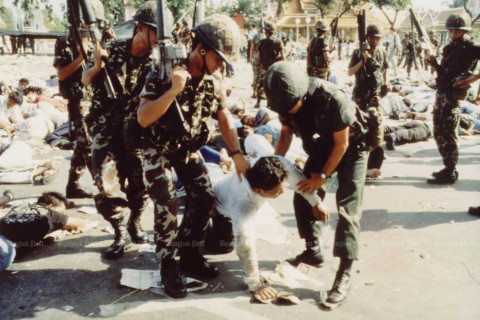
Remembering Bloody May 1992
Oped, Vitit Muntarbhorn, Published on 18/05/2022
» This month commemorates the 30-year anniversary of the Bloody May events in 1992 that witnessed extensive violence against street demonstrators and the subsequent fall of the military-linked government that had come to power due to the 1991 coup. What then are some of the lessons to remember, resonating from the past to the present and the future?