



Showing 1 - 10 of 11

Navigating between global superpowers
News, Vitit Muntarbhorn, Published on 14/02/2026
» Both China and the US issued new national security policies over the past year. At first glance, they seem to diverge markedly, portending a deep rupture in the world order. Yet, they may also bear some similarities in terms of self-interest and self-advancement. Collateral to that, other countries seeking to forge a middle path may wish to navigate a perspicacious route towards global equilibrium.

Thailand has human rights role to play
News, Vitit Muntarbhorn, Published on 04/11/2024
» The recent election of Thailand to the UN Human Rights Council (HRC) is, in a sense, a cause for elation. Yet it also comes with the responsibility of proving to the global/local community that the country can set an example for good practices and propel the HRC to take effective action on key matters based on international standards. This is daunting in a world of multi-and-mini polarities and poly-crises.

Govt kindles same-sex marriage hopes
News, Vitit Muntarbhorn, Published on 23/11/2023
» The top of the executive branch has given a welcome signal that it will fast-track in parliament a law to recognise same-sex marriage in Thailand.

Poll outcome invites shared wisdom
News, Vitit Muntarbhorn, Published on 22/05/2023
» That was the week that was, beginning on May 14, 2023, Thailand's monumental and momentous national election day. The results of the election were historically in favour of democratic change, with the Move Forward Party (MFP) gaining the most seats in the Lower House. It is leading a coalition of parties, aspiring to form the next government and winning over 310 seats in total, despite shenanigans from arch-conservatives.

Some good news for freedom of speech
Oped, Vitit Muntarbhorn, Published on 13/05/2023
» The World Press Freedom Day, concurrently May 3, was celebrated recently with a panel discussion at the Foreign Correspondents' Club of Thailand, which provided a fresh opportunity to catch up with news, especially on Thailand. It was also an occasion to reflect on international developments concerning the shrinking space for the free flow of information ("info-inhibition") in various settings.
Celebrating human rights in 2023
Oped, Vitit Muntarbhorn, Published on 02/02/2023
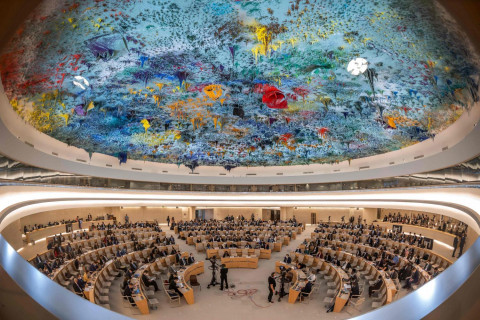
» This year is a time to remember and reiterate two key instruments which have shaped responses to human rights implementation since the end of World War II in 1945. It was the task of the Universal Declaration of Human Rights (UDHR), based on a Resolution of the UN General Assembly adopted in 1948, to identify and list a number of key rights of a global nature.
Cambodia's progress has been stalled
Oped, Vitit Muntarbhorn, Published on 31/03/2022
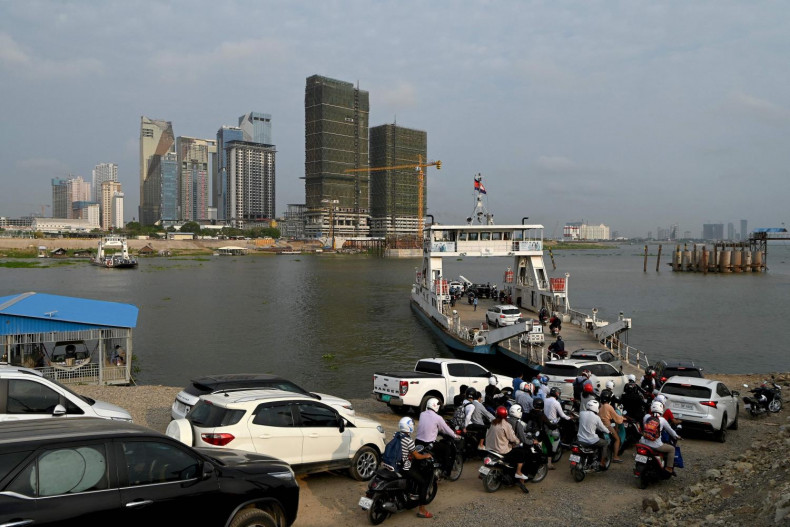
» The situation in Cambodia can perhaps be described as straddling a testament and a predicament. The testament is the 30th anniversary of the Paris Peace Agreements (October 1991) which brought peace to the country after a long period of warfare and the "recent tragic past". It established a pivotal framework for human rights, democracy and sustainable development in the country.
Protecting migrants, refugees in our age of conflict
News, Vitit Muntarbhorn, Published on 07/01/2020
» There are about 270 million international migrants today who cross borders in search of new vistas. Many such as "expatriates" do well. However, many, particularly those who are pushed out of their homes, are caught in a trap of dislocation, dispossession and coercion, often due to armed conflicts, discrimination and violence. The number of forced migrants now stands at about 70 million people globally -- some 30 million who cross borders as "refugees" and some 40 million forced to move in their country of origin as "internally displaced persons".
Time to end the detention of children
News, Vitit Muntarbhorn, Published on 29/01/2019
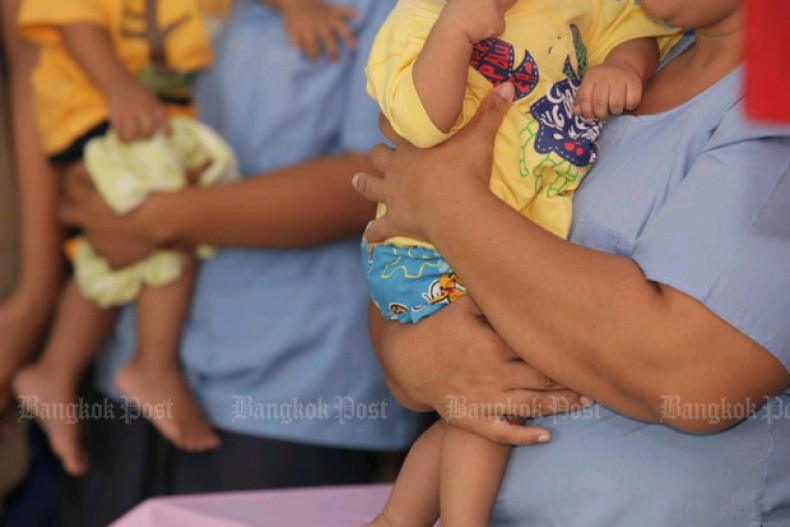
» The beginning of last week witnessed the signing ceremony of the Memorandum of Understanding (MoU) on the Determination of Measures and Approaches Alternative to Detention of Children in Immigration Detention Centres by seven key agencies in Thailand, namely: the Ministry of Foreign Affairs, the Ministry of Social Development, the Ministry of Interior, the Ministry of Education, the Ministry of Health, the Ministry of Labour and the national police (which deals with immigration).
Thai human rights body in state of flux
News, Vitit Muntarbhorn, Published on 13/08/2018
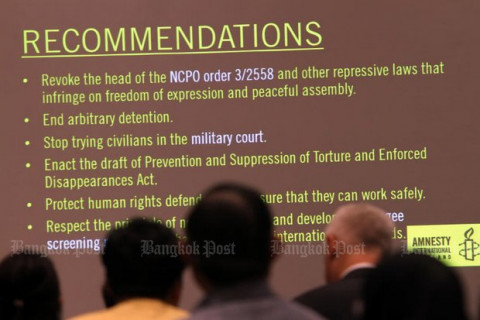
» It was the country's people-based 16th constitution (1997) which established Thailand's National Human Rights Commission. The expectation was that the commission would act as a promoter and protector of human rights, with due regard for universal standards, complementing the constitution and national laws. It would also be a check and balance mechanism, especially where the traditional pillars of the state might not be fulfilling their tasks or impinge on human rights.