



Showing 1 - 9 of 9
The gist of Thai politics over 20 years
Oped, Thitinan Pongsudhirak, Published on 20/02/2026
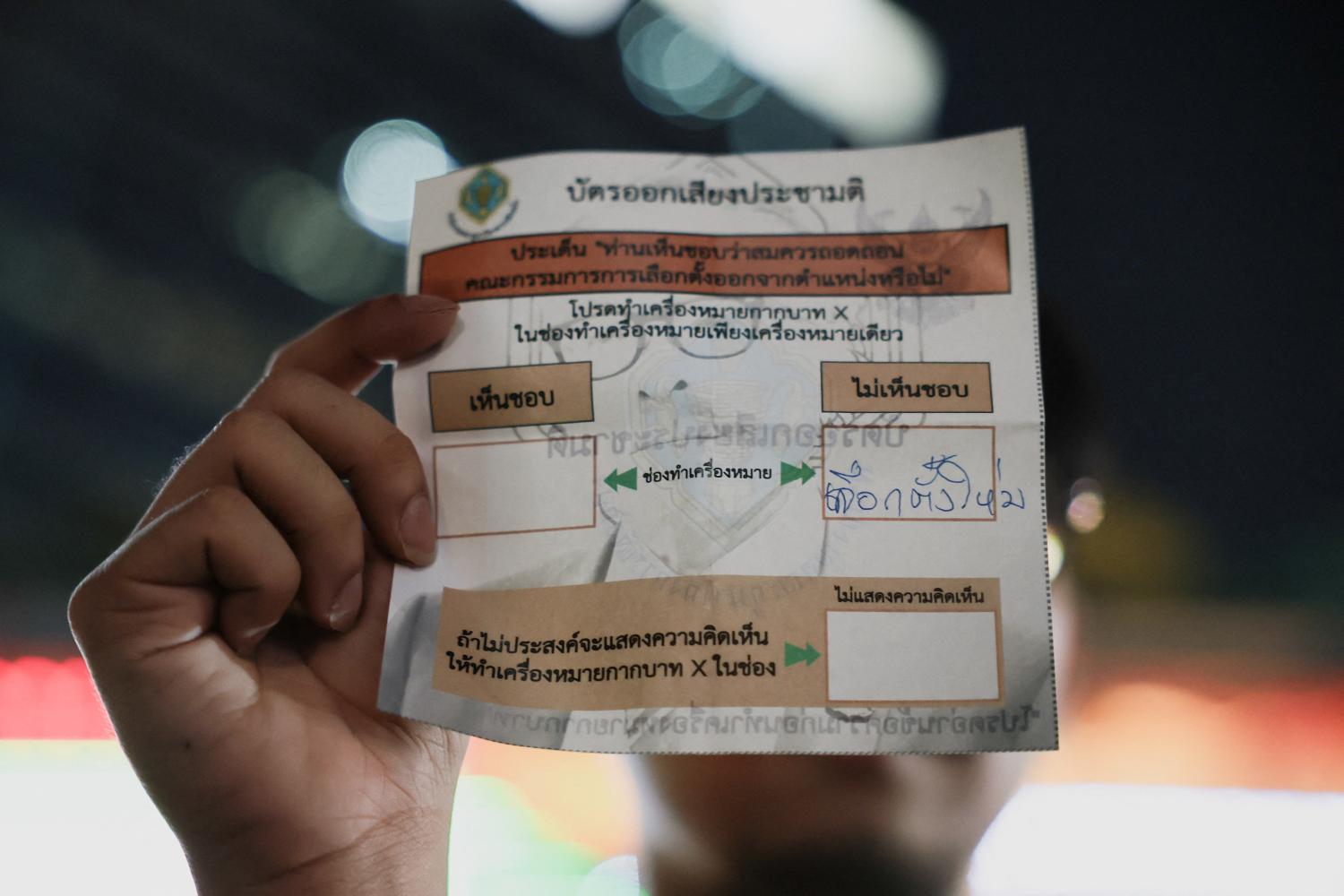
» Thailand's democratic institutions have been repressed and kept weak to the point that confusion still prevails almost two weeks after the Feb 8 election, which purportedly showed a clear victory for the ruling Bhumjaithai (BJT) Party under Prime Minister Anutin Charnvirakul. On the one hand, Mr Anutin and BJT stalwarts are busy forming a coalition government with other parties. On the other hand, fraud allegations from civil society groups and the opposition People's Party have reached a critical mass with the plausibility that the recent vote might be nullified to pave the way for a new poll.
Prayut government seems bullet-proof
Oped, Thitinan Pongsudhirak, Published on 21/05/2021
» The passage of time shows the government's growing lack of accountability. In fact, the government of Prime Minister Prayut Chan-o-cha appears the most unaccountable on record because it has been the most incompetent. Myriad charges from policy mismanagement and blatant irregularities to outright constitutional violations have been levied against the government but none have stuck. Although some attribute this phenomenon to Gen Prayut's "Teflon" qualities, a more accurate understanding may well be that his cabinet is somehow bullet-proof. Charges can stick but they cannot penetrate.

Covid success coming at a heavy price
Oped, Thitinan Pongsudhirak, Published on 17/07/2020
» It was a matter of time before the government of Prime Minister Prayut Chan-o-cha became a victim of its own misguided success in handling the coronavirus pandemic. By presiding over a public mindset of "zero" local virus infections, the government raised unrealistic expectations at a high price. The fiasco that transpired in Rayong last week, when an infected Egyptian air force official was allowed to roam in a shopping mall and thereby fuelled fears of "second wave" infections, should serve as a wake-up call for an overdue change in virus-fighting strategy.

Undue politicisation at finance and BoT
Oped, Thitinan Pongsudhirak, Published on 03/07/2020
» Thailand's economic growth projections continue to head south as the coronavirus crisis unfolds in the second half of the year. In its most recent forecast, the Bank of Thailand anticipates a sharp contraction of 8.1% this year, worse than the 5.3% it predicted in March. Downside macroeconomic risks are substantial as the Covid-19 pandemic could still degenerate and cause further global health and economic havoc. In this dire environment, Thailand will need steady and seasoned hands to oversee macroeconomic levers. Yet both the finance ministry portfolio and the BoT governorship now face uncertainty and potential politicisation that bode ill for effective and autonomous fiscal and monetary policies.

Geoeconomic implications of Covid-19
Oped, Thitinan Pongsudhirak, Published on 26/06/2020
» The longer the coronavirus pandemic wends its way around the world, the more it takes on permanent features. As case infections still persist virulently, especially in the US, Brazil, Russia and India, states, societies and individuals are being forced to make adjustments. There will be winners and losers in the geoeconomic competition for market shares and supply chains. Those with more effective public health systems will stand in good stead with opportunities to re-emerge less scathed and better positioned to carry on, whereas others with less adequate health infrastructure will face more risks and disadvantages. For the first time in generations, health security has become the main determinant in the fate of nations and peoples.

Thailand's strategic path is rudderless
News, Thitinan Pongsudhirak, Published on 19/06/2020
» As the coronavirus pandemic continues to wreak havoc worldwide, domestic tension and pressure will compel three broad responses from the various afflicted countries. First, these countries may react to virus-induced domestic challenges by blaming and taking it out on outsiders. Alternatively, they may be so preoccupied at home that they become marginalised abroad. In other instances, countries that have coped effectively with Covid-19 will be able to regain their footing faster and move on sooner as the rest of the pack remains bogged down in acrimony and discord.

Top brass, technocrats, politicos all same
Oped, Thitinan Pongsudhirak, Published on 12/06/2020
» When ostensible technocrats become ambitious politicians, supervised by army generals and beholden to patronage-driven elected politicians, the result is a power struggle, internal party turmoil, and a country being governed to nowhere. This is the current state of Thailand's ruling Palang Pracharath Party (PPRP), the head of a motley and fractious 19-member coalition of minor and micro parties, some represented by one single MP, propping up the government of former coup leader and current Prime Minister Prayut Chan-o-cha. Yet in the face of the opposition bloc that is weak because it has been weakened, after the third-largest winner the Future Forward Party from the last election was dissolved earlier this year, the PPRP is on course to be in office for the foreseeable future, as a new poll is not due for another three years. These dire dynamics suggest Thailand will continue to be rudderless, stuck in a quagmire of its own making, with headwinds that may lead to a reckoning tempest.

Geopolitical outcomes beyond Covid-19
Oped, Thitinan Pongsudhirak, Published on 15/05/2020
» The coronavirus crisis is on course to significantly reshape and realign the pecking order among nations in geopolitics. Rather than a fundamental shift in patterns and contours, the likely geopolitical outcomes beyond Covid-19 appear to reinforce pre-existing trends and dynamics. As the two competing superpowers, neither the United States nor China will come out of the pandemic period with flying colours.

Challenges from outside parliament
News, Thitinan Pongsudhirak, Published on 06/03/2020
» While it managed to survive the recent censure debate more comfortably that it had anticipated, Prime Minister Prayut Chan-o-cha's government is now at a new crossroads. While the threat from inside parliament has subsided owing to the opposition's disarray, challenges from outside the legislative chamber, on the streets and in the court of public opinion are likely to intensify.