



Showing 1 - 10 of 13
Thailand's costly political shenanigans
Oped, Thitinan Pongsudhirak, Published on 22/08/2025
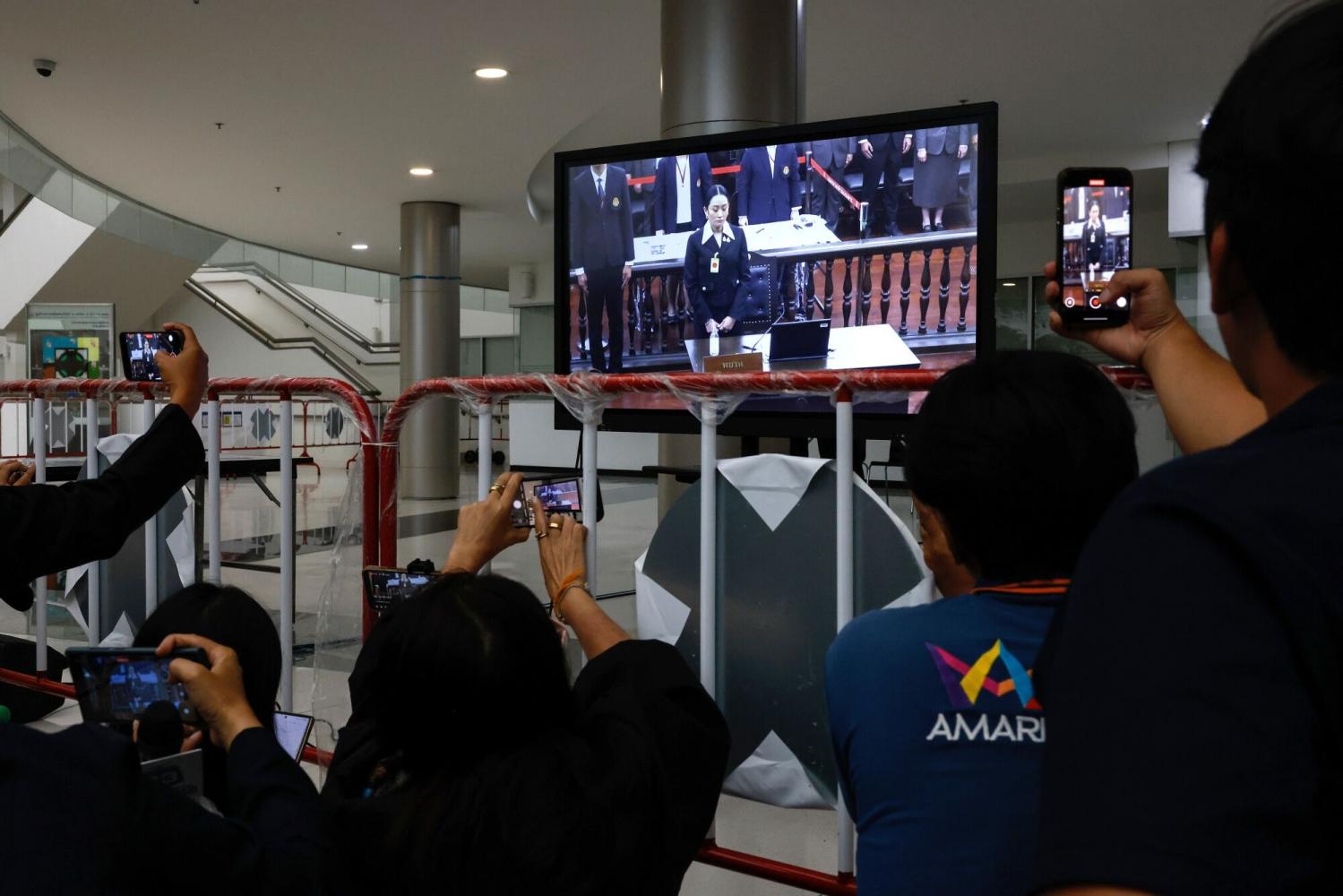
» In a country of 70 million where a handful of men can remove an elected government time and again, there can be no stability and progress, only tension and regression. This is how Thailand can be characterised over the past two decades. It is now going through yet another cycle of heightened political instability with the potential collapse of the government under suspended Prime Minister Paetongtarn Shinawatra in the footsteps of previous leaders who were similarly ousted by the Constitutional Court.

Prospects at home and abroad in 2024
Oped, Thitinan Pongsudhirak, Published on 05/01/2024
» Overlooked but deeply consequential, 2024 will be the first time in a decade that Thailand is ruled by a civilian-led government. Whatever frustration and disenchantment that arise this year, memories must not run short. Thailand suffered deeply under the coup-backed regime of Gen Prayut Chan-o-cha. Seeing his back is politically good riddance, and having Srettha Thavisin as a thoroughly civilian and pro-business prime minister bodes well for the country. Yet Mr Srettha has his work cut out to boost the economy, address constitutional reform, restore Thailand's international standing, and stay in office into next year amid the global economic slowdown.

Thailand's semi-democracy faces risks
Oped, Thitinan Pongsudhirak, Published on 15/12/2023
» The government of Prime Minister and Finance Minister Srettha Thavisin has settled into an uneasy balance between the civilian-led majority forces that represent the Thai electorate and the royalist-conservative minority guardians of the established centres anchored around the monarchy, military, judiciary, and bureaucracy.

Thailand's semi-democracy returns
Oped, Thitinan Pongsudhirak, Published on 01/12/2023
» The appointment of Gen Prayut Chan-o-cha as privy councillor has neatly bookended Thai politics over the past decade. It coincides with the 10-year anniversary of the street demonstrations that were led by the People's Democratic Reform Committee, paving the way for Gen Prayut to stage a military coup in May 2014. While the interim was a period of hard and soft military-authoritarian rule in 2014-19 and 2019-23, the new moving balance in Thai politics is a semi-democracy of sorts under the Pheu Thai Party-led coalition government.

Global, regional, local trends for 2023
Oped, Thitinan Pongsudhirak, Published on 23/12/2022
» Although economic predictions are usually reserved for the foolhardy, as the future is always difficult to ascertain, there are certain trend lines and probabilities that can be discerned at the global and regional level as well as the local level here in Thailand. As a year-end exercise, we can tease out a few contours with a reasonably high degree of probability.

Japan's post-Covid regional dilemma
Oped, Thitinan Pongsudhirak, Published on 21/01/2022
» Among the major powers that are moving forward with an eye on the post-pandemic era, when Covid-19 will eventually become an endemic with flu-like manageability, Japan is second to none. The visit last week by its minister of economy, trade, and industry (METI), Koichi Hagiuda, made front-page news in Bangkok, following similarly notable media coverage in Jakarta and Singapore. But while it has played a critical role in Asean's economic development and regional security, Japan's Indo-Pacific geostrategic environment has become adverse with more downside risks.

Aukus poses challenges to other powers
Oped, Thitinan Pongsudhirak, Published on 15/10/2021
» The Australia-United Kingdom-United States (Aukus) security pact has caused ripple effects across oceans and continents. Not only will the trilateral security partnership provoke China, but it will likely further divide Southeast Asia and overshadow Asean-centred cooperative vehicles, such as the East Asia Summit. Beyond these concerns, the Aukus deal to share Anglo-American nuclear technology to enable Australia's acquisition of eight nuclear-powered submarines over two decades poses challenges to other major powers, particularly the European Union and its key members as well as Japan.

Moral dilemmas of handling the virus
Oped, Thitinan Pongsudhirak, Published on 03/04/2020
» It is hard to calibrate a commensurate response to the coronavirus (Covid-19) pandemic. Owing to the lack of accurate and reliable information, a media feeding frenzy and the mass psychology of fear, the choice has become all or nothing, not much in between. Individuals, societies and states worldwide are now incentivised to overdo it and err on the side of caution, being safe rather than sorry. This means that the likelihood of "overshooting" with Covid responses is likely to heighten in the foreseeable future in view of morally unacceptable alternatives.

Rail deals must have accountability
News, Thitinan Pongsudhirak, Published on 03/05/2019
» Prime Minister Prayut Chan-o-cha's recent participation in the second Belt and Road Forum (BRF) in Beijing was problematic on many levels. On what basis did Gen Prayut negotiate a rail deal between Thailand and China? What are the details and cost-benefit considerations of this deal? The lack of transparency and public accountability surrounding the Thailand and China rail plan is likely to pose future questions and problems for a huge infrastructure project Thailand can use, but according to whose terms its people must be the main beneficiary.

China's Belt & Road needs to listen more
News, Thitinan Pongsudhirak, Published on 30/11/2018
» In the aftermath of a tense Asean-led summit season, it is clear now that the United States and China are engaged in a great-power competition not seen since the Cold War. The US-China trade war, irrespective of negotiated talks in Buenos Aires between President Donald Trump and President Xi Jinping, is set to deteriorate over the next two years and probably longer. The two superpowers may have fundamental and structural differences that cannot be resolved without a sweeping deal that realigns their geopolitical status and geoeconomic interests in a way that is acceptable to both, an unlikely prospect. So the confrontation will likely intensify.