



Showing 1 - 10 of 60
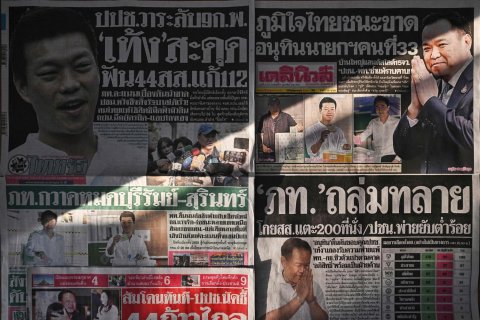
Implications of conservative triumph
Oped, Thitinan Pongsudhirak, Published on 13/02/2026
» The incumbent and conservative Bhumjaithai (BJT) Party has surprisingly swept Thailand's Feb 8 election with a commanding win. With the previously poll-leading and progressive People's Party (PP) coming in a distant second, Thailand appears headed for a conservative coalition government revolving around BJT and like-minded junior partners. Known for its conservative stance and being pro-status quo, it would not be surprising if the BJT-led coalition government, led by Prime Minister-elect Anutin Charnvirakul, were not challenged by the Constitutional Court, the Election Commission, and other supervisory agencies, which have derailed and dissolved reform-minded winning parties in the past.

Will poll be breakout or more of same?
Oped, Thitinan Pongsudhirak, Published on 06/02/2026
» As Thais go to the polls this Sunday, the most consequential question is whether Thailand will finally break out of its debilitating cycle of political instability and economic underperformance that has marked the past two decades. The signs and signals suggest otherwise -- at least not yet.
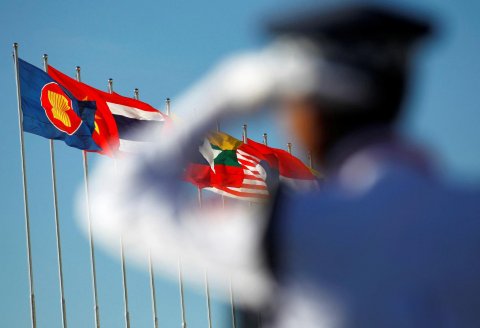
Flawed Asean needs to regain footing
Oped, Thitinan Pongsudhirak, Published on 10/10/2025
» Nearly six decades after its founding, the Association of Southeast Asian Nations (Asean) finds itself back where it began -- divided, uncertain, and vulnerable to the influence of major powers. Once hailed as a model for regional cooperation in the developing world, Asean now faces a crisis of purpose. Unless it can rediscover the unity and collective way forward that defined its early decades, Southeast Asia's flagship institution risks slipping into irrelevance.
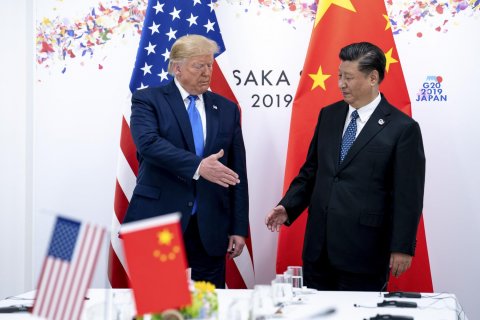
Southeast Asia amid the US-China rift
Oped, Thitinan Pongsudhirak, Published on 03/10/2025
» The rivalry between the United States and China has become the defining contest of the 21st century. Barely two decades ago, Washington and Beijing were partners in prosperity. America's support for China's entry into the World Trade Organization in 2001 epitomised the high-water mark of engagement, reflecting the belief that economic integration would lead to greater political cooperation. Today, that partnership has morphed into suspicion and confrontation. Relations between the United States and China have deteriorated so swiftly that many observers now describe them as locked in a "new Cold War". The more pressing question, however, is not whether this analogy holds, but whether confrontation can be managed short of outright conflict.
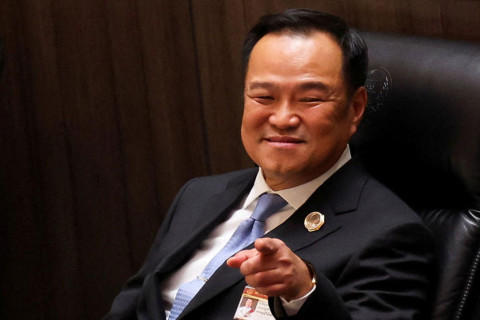
New govt may last longer than pledged
Oped, Thitinan Pongsudhirak, Published on 12/09/2025
» Thailand's latest round of political tumult reached a culmination when the Constitutional Court removed Paetongtarn Shinawatra of the hitherto ruling Pheu Thai (PT) Party from office on Aug 29, paving the way for Bhumjaithai Party (BJT) leader Anutin Charnvirakul to succeed her as prime minister with the Lower House's majority support a week later.

What's happened to the Asian Century?
Oped, Thitinan Pongsudhirak, Published on 14/02/2025
» Until recently, the "Asian Century" seemed a compelling narrative but now it is not what it used to be. It was supposed to herald a shift in global economic power from the West to the East, driven by China's rapid rise, India's economic dynamism, and the broader development of Asia. But a quarter of the way into the 21st century, the promise of Asian dominance appears less certain. The enduring technological and economic might of the United States, coupled with its geopolitical backlash against China, has lowered expectations. While Asia remains formidable, the trajectory of global power is open and fluid, with potential dominance shifting not necessarily to any nation or region but perhaps to a non-state entity.
Myanmar's civil war after four years
Oped, Thitinan Pongsudhirak, Published on 31/01/2025
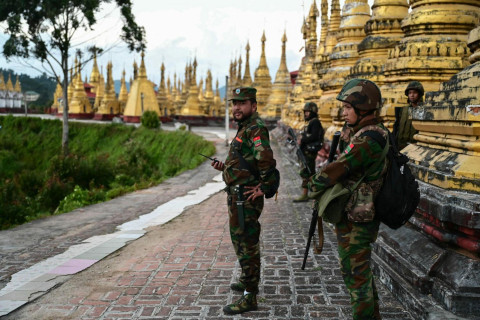
» Four years after its military coup and consequent civil war, Myanmar's spotlight in global headlines continues to dim as geostrategic reorientations and realignments among the major powers take centre stage. Dramatic and drastic foreign policy changes are afoot in the United States under the second administration of President Donald J Trump, while the European Union faces an existential threat from Russia's aggression in Ukraine, and Japan is mired in political sclerosis at home. Myanmar's fate and future will thus likely be determined by the course and outcome of its civil war, China's expanding influence in the country and Asean member states' manoeuvres to a lesser extent.

Indonesia leads Asean into Brics+
Oped, Thitinan Pongsudhirak, Published on 17/01/2025
» As the new year gets underway with the looming re-inauguration of United States President Donald J Trump, countries and entire regions are having to manoeuvre and realign in view of an accelerated breakdown of the post-Second World War rules-based liberal international order.

Thai politics has turned upside down
Oped, Thitinan Pongsudhirak, Published on 23/08/2024
» The rise of Prime Minister Paetongtarn Shinawatra and the return -- and re-entry, of her father, Thaksin Shinawatra, have turned Thai politics upside down. On the surface, Mr Thaksin still dominates Thai politics nearly 20 years after he was deposed by a military coup and exiled for most of that period. This time, his political power and influence are being exercised through his daughter Ms Paetongtarn. As the Shinawatra clan has been coopted by its former establishment adversaries, the past two decades of periodic elections, street protests, two military coups, two constitutions, and multiple judicial bans on political parties and elected politicians have entered a new chapter.

Thailand between the US and China
Oped, Thitinan Pongsudhirak, Published on 29/03/2024
» Amid what now has to be acknowledged as a direct non-military conflict and a geoeconomic war of sorts between the United States and China, Thailand is in a quandary. While characterising Thailand's geostrategic dilemma as a US-China binary can be exaggerated and misleading, it does have a point. As with many other developing countries in the region, Thailand will come under increasing pressure to choose between the two competing superpowers. The ability not to choose thus becomes an overarching geostrategic objective.