



Showing 1 - 4 of 4

What's happened to the Asian Century?
Oped, Thitinan Pongsudhirak, Published on 14/02/2025
» Until recently, the "Asian Century" seemed a compelling narrative but now it is not what it used to be. It was supposed to herald a shift in global economic power from the West to the East, driven by China's rapid rise, India's economic dynamism, and the broader development of Asia. But a quarter of the way into the 21st century, the promise of Asian dominance appears less certain. The enduring technological and economic might of the United States, coupled with its geopolitical backlash against China, has lowered expectations. While Asia remains formidable, the trajectory of global power is open and fluid, with potential dominance shifting not necessarily to any nation or region but perhaps to a non-state entity.

Trump II's intellectual foundations
Oped, Thitinan Pongsudhirak, Published on 22/11/2024
» It seems counterintuitive and contradictory to think of an intellectual foundation behind United States President-elect Donald J Trump when he is professedly unintellectual, even anti-intellectual. But make no mistake. Mr Trump is merely a phenomenon. Understanding it reveals his worldview and consequent policy prospects. But doing so requires seeing the Trump phenomenon as it is rather than why and how it is detested by countless millions of us. Indeed, the biggest difficulty when analysing Mr Trump and his second administration is the global disdain he elicits.

The global politics of virus vaccines
Oped, Thitinan Pongsudhirak, Published on 11/09/2020
» It is clear now that Thailand's de facto strategy for handling the coronavirus pandemic is to minimise local infections and wait for a safe and effective vaccine. The recent discovery of just one Thai in a Bangkok suburb who tested positive sent the country into near-panic mode after 100 days of zero local transmissions, similar to the case of an Egyptian military official who visited Rayong province in July and tested positive thereafter.
The Indo-Pacific and Asean centrality
News, Thitinan Pongsudhirak, Published on 01/06/2018
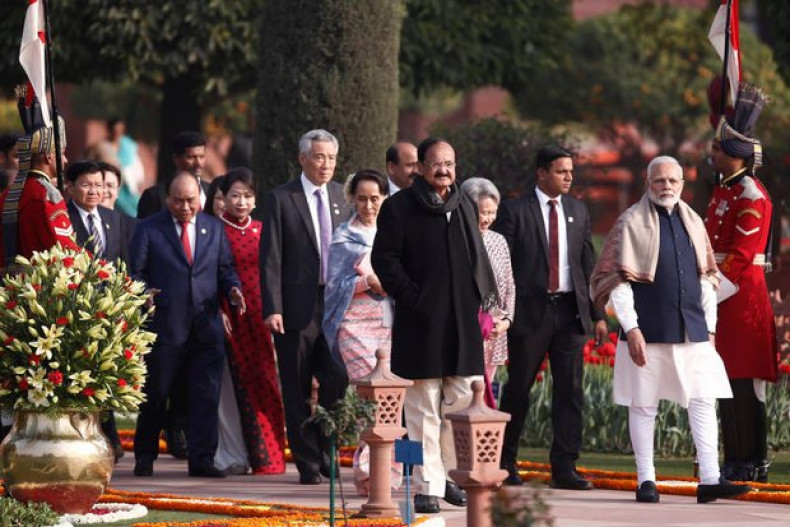
» Even though US President Donald Trump repeatedly alluded to it in his speeches at Asean-led summits in Danang and Manila late last year, and despite its reference in both the United States National Security Strategy and National Defence Strategy, the geographic notion of a "free and open Indo-Pacific" (FOIP) straddling both the vast Pacific and Indian oceans has been given short shrift in many capitals. Chinese Foreign Minister Wang Yi suggested last March that the Indo-Pacific was only an "attention-grabbing idea", akin to "the sea foam in the Pacific and Indian Ocean" that "may get some attention but will soon dissipate". Asean leaders have paid some attention but have not had a collective and cohesive reaction to it. But now everyone in Asian security circles and beyond will take notice.