



Showing 1 - 10 of 11
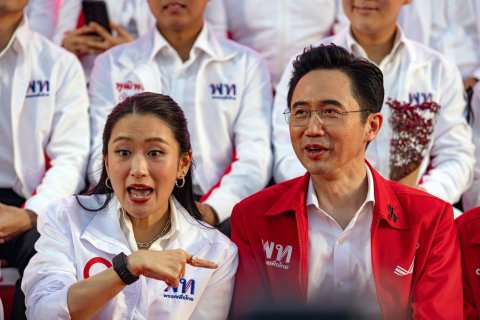
Three main parties and two directions
Oped, Thitinan Pongsudhirak, Published on 16/01/2026
» Although Thailand's election campaign is reaching fever pitch ahead of voting day on Feb 8, the dynamics and contours of its final outcome can be gleaned from past polls over the last 25 years. Only once in January 2001, as was indicated in this space last week, were voter results fully honoured and carried out. Other elections were either upended by military coups or manipulated by judicial interventions.

Another wasted year in Thai politics
Oped, Thitinan Pongsudhirak, Published on 26/12/2025
» As Thailand winds down 2025 with an early election looming on Feb 8, the most consequential issue to watch in the coming year will be whether recent topsy-turvy political patterns of polls, protests, and military and judicial interventions give way to a compromise between the old guard clinging on to vested interests and the new generation clamouring for reform and change.
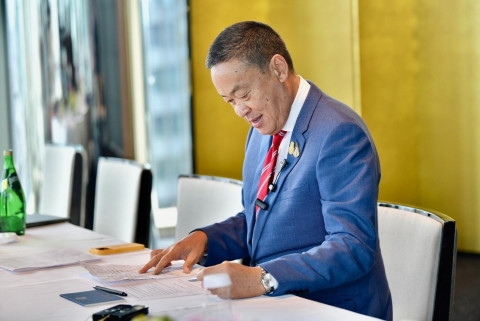
Thailand's judiciary faces challenges
Oped, Thitinan Pongsudhirak, Published on 24/05/2024
» Thailand appears to be a country of 70 million, ultimately ruled by an unelected few. This sobering reality was on display when two connected groups of top generals seized power from democratically elected governments in September 2006 and May 2014. Unlike these blatant military coups over the past two decades, at issue now is the power and role of the judiciary. While Thailand has another democratically elected civilian government under Prime Minister Srettha Thavisin, the question that needs to be asked is whether the country is effectively under judicial rule.
Reshuffle cements Srettha's grip
News, Thitinan Pongsudhirak, Published on 06/05/2024
» After eight months at the helm, Prime Minister Srettha Thavisin staged a much-anticipated cabinet reshuffle with unexpected drama and unsurprising consolidation. As head of a coalition government, Mr Srettha appears more "prime ministerial" as the reshuffle has strengthened his hand to implement the ruling Pheu Thai Party's flagship policies.
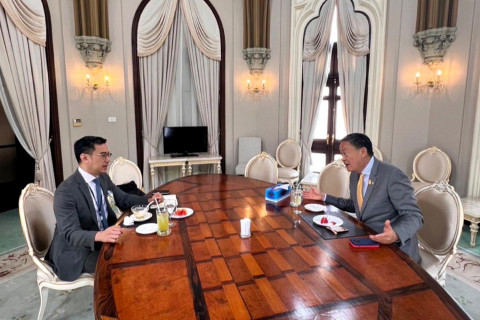
Thailand's central bank dependence
Oped, Thitinan Pongsudhirak, Published on 23/02/2024
» To proponents of central bank independence, the ongoing friction between Prime Minister and Finance Minister Srettha Thavisin and Bank of Thailand Governor Sethaput Suthiwartnarueput appears straightforward. The prime minister is putting unwarranted and unfair pressure on the central bank governor to spur the economy by loosening monetary policy and cutting interest rates. Yet, on closer scrutiny, the entrenched politicisation of central banking in Thailand may suggest otherwise. There is more than meets the eye in the politics of interest rate cuts.
Global, regional, local trends for 2023
Oped, Thitinan Pongsudhirak, Published on 23/12/2022
» Although economic predictions are usually reserved for the foolhardy, as the future is always difficult to ascertain, there are certain trend lines and probabilities that can be discerned at the global and regional level as well as the local level here in Thailand. As a year-end exercise, we can tease out a few contours with a reasonably high degree of probability.

Reopening a good bet with high costs
Oped, Thitinan Pongsudhirak, Published on 12/11/2021
» Nearly two weeks into Thailand's official reopening during the Covid-19 pandemic, it is time to evaluate the country's vaccine management plan, economic costs and prospects of recovery. While the reopening is worth the attendant risks, Thailand is paying a disproportionately high price for earlier mistakes and the government's mismanagement. As the reopening phase builds up, the Thai economy is likely to see a weak and tentative recovery trajectory with medium-term challenges and question marks.

Regional vaccine approach is imperative
Oped, Thitinan Pongsudhirak, Published on 14/05/2021
» As vaccine diplomacy thrives and vaccine nationalism rears its head, it has become clear that the ideal global solution to the collective action problem of the coronavirus pandemic is for all countries to put their eggs in the same basket. If all countries are forced to rely on the global vaccine alliances' and the World Health Organization's Covid-19 Global Vaccines Access (Covax) plan, whereby any vaccine for one means an available antidote for all, the post-pandemic recovery would arrive faster and smoother with more promising prospects. But short of the ideal solution, the global health system is largely based on self-help, each country mapping its own plan for recovery with a mix of procurement strategies.
Undue politicisation at finance and BoT
Oped, Thitinan Pongsudhirak, Published on 03/07/2020
» Thailand's economic growth projections continue to head south as the coronavirus crisis unfolds in the second half of the year. In its most recent forecast, the Bank of Thailand anticipates a sharp contraction of 8.1% this year, worse than the 5.3% it predicted in March. Downside macroeconomic risks are substantial as the Covid-19 pandemic could still degenerate and cause further global health and economic havoc. In this dire environment, Thailand will need steady and seasoned hands to oversee macroeconomic levers. Yet both the finance ministry portfolio and the BoT governorship now face uncertainty and potential politicisation that bode ill for effective and autonomous fiscal and monetary policies.
Central bank autonomy must be upheld
News, Thitinan Pongsudhirak, Published on 16/08/2019
» When elected governments make noises about economic growth in countries where macroeconomic management is sound and prudent, central bankers tend to quietly bristle and brush off such interference and infringement of monetary space at their own risk. In so doing, central bankers tend to enjoy the support of domestic and international market participants who value central bank independence more than politicians' vested interests, even if it sometimes undercuts their bottom lines. Accordingly, when central bankers go along with the preferences of elected politicians, the conduct of monetary policy comes into question.